
AI in Healthcare: Revolutionizing Patient Care

- Description
- Curriculum
- Notice
- Reviews
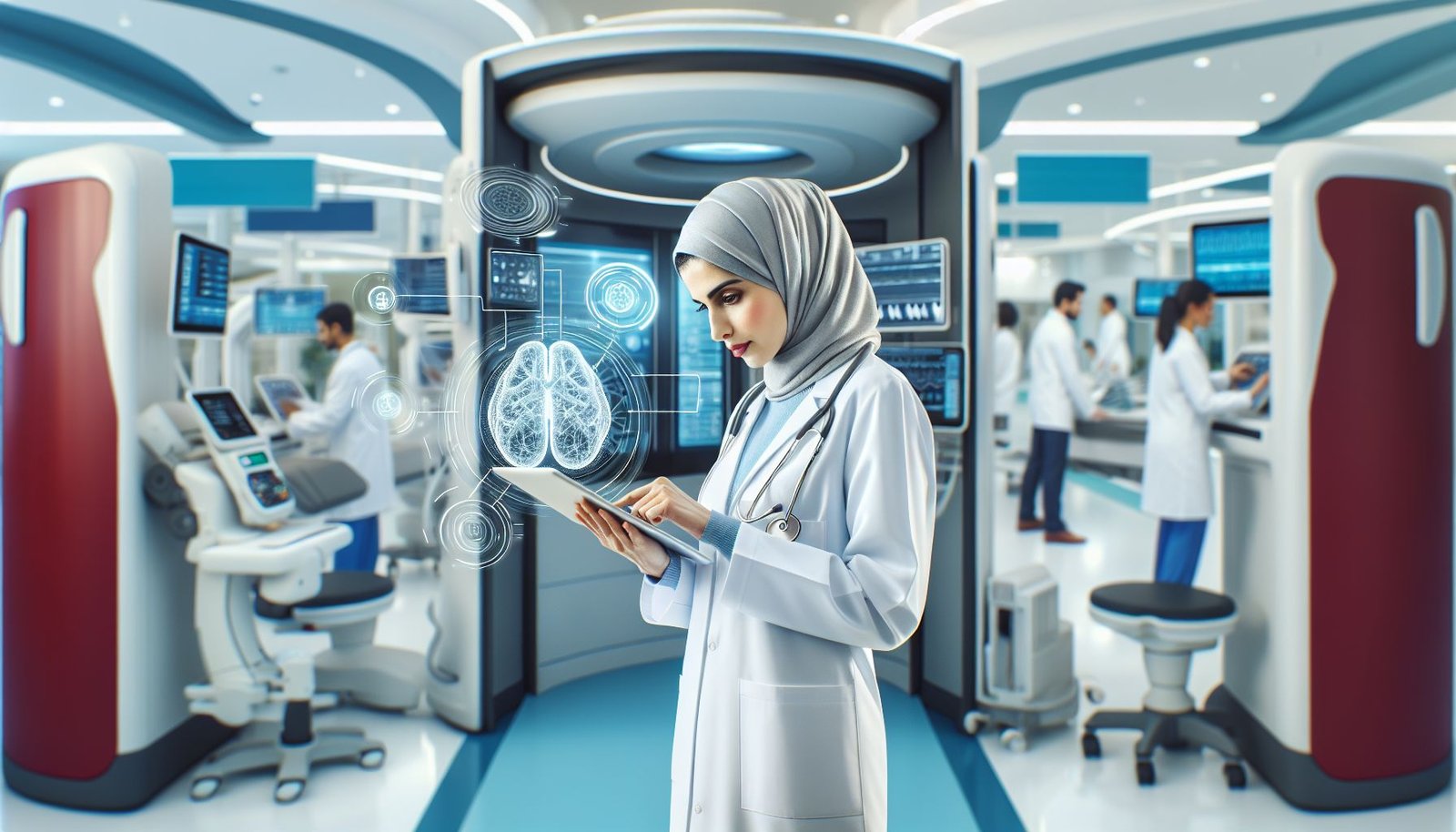
Introduction to the Course
Welcome to the course on AI in Healthcare: Revolutionizing Patient Care. This course is designed for medical doctors, healthcare professionals, medical students, and healthcare IT professionals who are eager to understand and implement AI in their practice.
Course Objectives
- Understand the fundamentals of AI and its applications in healthcare.
- Explore real-world examples and case studies of AI transforming patient care.
- Learn about the ethical and regulatory considerations of AI in healthcare.
- Develop practical skills to integrate AI solutions into clinical practice.
Engaging Stories
Throughout this course, you will encounter inspiring success stories of AI improving patient outcomes and streamlining clinical processes. These real-world examples will illustrate the transformative power of AI in healthcare.
Interactive Pre-Course Survey
To tailor the learning experience to your needs, we invite you to participate in an interactive pre-course survey. This will help us understand your background and expectations, ensuring that the course content is relevant and valuable to you.
-
1
 Understanding Artificial Intelligence
 -
2
Machine Learning
-
3
 Quiz: What is Supervised Learning? Supervised Learning is a type of machine learning where the algorithm learns from:
 -
4
Deep Learning and Neural Networks
Deep Learning is a subset of ML that uses neural networks with many layers (hence "deep") to analyze various factors of data. Neural Networks are inspired by the human brain's network of neurons and are used for tasks such as image and speech recognition.
-
5
What is a key characteristic of Deep Learning? Deep Learning uses:What is a key characteristic of Deep Learning? Deep Learning uses:
-
11
Introduction to Machine Learning in Healthcare
Machine learning (ML) is a subset of artificial intelligence (AI) that enables computers to learn from data and make predictions or decisions without being explicitly programmed. In healthcare, ML has the potential to revolutionize patient care by enhancing diagnostics, treatment planning, and administrative processes.
-
12
Supervised vs. Unsupervised Learning
-
13
Hands-On Coding Exercise
-
14
Which of the following is an example of supervised learning?
-
15
Basics of Deep Learning
Deep learning is a subset of machine learning that uses neural networks with many layers (hence "deep") to analyze various types of data. In healthcare, deep learning is particularly useful for image analysis.
-
16
Sort each term into its definition:
-
17
Convolutional Neural Networks (CNNs) for Image Analysis
-
18
Match each CNN layer with its function
-
19
Applications in Radiology and Pathology
-
20
Understanding Natural Language Processing (NLP) in Healthcare
-
21
Case Study: NLP in Action at Mount Sinai Hospital
Case Study: NLP in Action at Mount Sinai Hospital
-
22
What was one of the key benefits of implementing the NLP system at Mount Sinai Hospital?
-
23
Interactive Project: Extracting Insights from EHR Data
In this project, you will use NLP techniques to extract insights from a sample Electronic Health Record (EHR) dataset. Follow these steps:
Data Preparation: Download the sample EHR dataset provided.
NLP Implementation: Use an NLP tool or library (such as NLTK or spaCy) to process the unstructured data in the EHRs.
Insight Extraction: Analyze the processed data to identify key trends, patterns, and insights.
Reporting: Create a report summarizing your findings and how they could be used to improve patient care.
-
24
Introduction to AI-Driven Diagnostic Tools
-
25
Case Study: Implementing AI in Radiology
-
26
What was one of the primary benefits of implementing the AI-driven diagnostic tool in the radiology department?
-
27
Interactive Case Analysis: AI in Cardiology
Consider a scenario where an AI-driven diagnostic tool is implemented in a cardiology department. The tool analyzes electrocardiograms (ECGs) to detect heart conditions such as arrhythmias and myocardial infarctions.
-
28
What is a potential challenge of implementing AI in cardiology?
-
37
Steps to Implement AI Solutions
-
38
Overcoming Implementation Challenges
-
39
Interactive Roadmap Creation for AI Integration
In this activity, you will create a personalized roadmap for integrating AI into your clinical practice. Follow the steps below to develop your roadmap.
-
40
Match the following elements with their descriptions:
AI in Healthcare: Revolutionizing Patient Care
Course Objectives
-
Understand the fundamentals of AI and its applications in healthcare.
-
Explore real-world examples and case studies of AI transforming patient care.
-
Learn about the ethical and regulatory considerations of AI in healthcare.
-
Develop practical skills to integrate AI solutions into clinical practice.